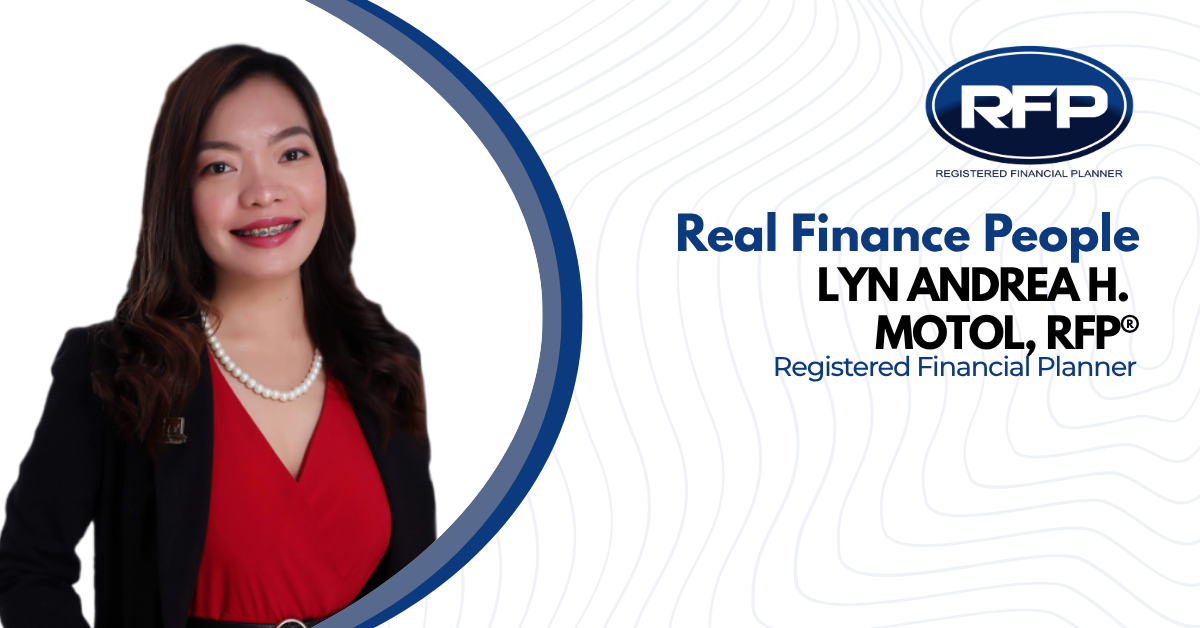
Lyn Andrea H. Motol, RFP®, is a financial professional, Registered Financial Planner, Licensed Professional Teacher, Licensed Financial Consultant of Pru Life UK since 2018, and Personal Finance Speaker. As a 5X National Achiever in financial consulting, she brings together financial advisory experience, education, and personal advocacy in helping individuals and families understand money with greater clarity and confidence.
Motol’s financial philosophy is deeply shaped by her early experience of seeing how lack of money can create instability and conflict. Her journey from scarcity thinking to intentional financial planning has strengthened her belief that money is not simply about income, but about systems, habits, preparation, and values-based decision-making. Through her RFP® credential and work as a financial advisor and speaker, she exemplifies a reflective, client-centered, and purpose-driven professional committed to helping others build stronger financial foundations.
RFP® Certification Story
Early Realization That Lack of Money Creates Chaos
“Lack of money means chaos.
That’s the lesson I learned early — and I learned it the hard way. I’m the sixth of eight children. My father was a jeepney driver, until one day he decided he simply didn’t want to work anymore. My mother stepped in and took on the responsibility of raising all eight of us. She worked as a sewer to keep food on the table. And from that point on, what I remember most about my childhood isn’t warmth or comfort. It’s the sound of fights. Every single day.
That experience taught me something people don’t like to admit: it’s easy to romanticize the idea that ‘when we’re hungry, love will keep us alive.’ It sounds beautiful in a song. But in real life? That’s not how it works. When your children are hungry, love and romance are not the most important things in a marriage. Stability is. Provision is. Because when there’s no money, there’s no peace — there’s only chaos.
That’s the mindset I carried out of my childhood, and honestly, it’s the reason I do what I do today.”
Learning That Money Supports Stability and Possibility
“Growing up, the biggest lesson I learned is this: happiness has a price tag.
Now, we all define happiness differently — but if you really dig deep, almost every version of it requires money to sustain.
Take quality time with family. You can’t fully be present with the people you love when your bills are unpaid and your mind is somewhere else. Healthy food — that’s a budget line, not a given. A quiet, safe environment to live in. Access to good healthcare when someone gets sick. Competent schools that give your kids a real shot at a better future. Even creativity — the freedom to explore, to dream, to try something just because you want to. That’s a luxury you don’t get when you’re in survival mode. Survival mode doesn’t leave room for imagination. It only leaves room for what’s next, and how do we get through it.
So growing up, I learned that money isn’t the point of life, but it’s the foundation that makes almost everything else possible.
If there’s one thing I wish I’d learned earlier, though, it’s this: money problems are rarely just about money. They’re about systems, habits, decisions, a lack of planning, sometimes even the choices of people around you that you have no control over. I used to think our family’s chaos was just ‘bad luck.’ It took me years to understand that with the right financial systems in place — even modest ones — a lot of that chaos could have been prevented.”
Financial Turning Point Through Unlearning Scarcity Thinking
“Growing up in a financially struggling household, I was always afraid to spend. There was this quiet anxiety that came with unfamiliar spaces too — anywhere I sensed I couldn’t afford to be.
That started to shift when I joined a religious group in Baliwag, Bulacan. There, we crossed paths with sponsors who were genuinely wealthy — and they brought us to places we’d never been, let us try food we’d never tasted, and gave us a front-row seat to a completely different way of living.
That’s when I really started observing how rich people act, how they talk, how they make decisions. They were calm. They didn’t panic easily. They weren’t quick to get irritated. They spoke differently. And when they bought things, price wasn’t the deciding factor — quality and value for money were. They were also generous and unafraid to spend on a better experience when it mattered.
That contrast made something click for me: most of our anxiety around money doesn’t actually come from not having — it comes from fear. The thought of ‘what if something unexpected happens and I can’t afford it.’ The pressure to always choose the ‘right’ and ‘best’ item, because sayang ang pera kung hindi — because wasting money feels unforgivable when you don’t have much of it to begin with.
When you grow up that way, you don’t buy what makes you happy. You don’t buy what you actually want. You buy based on how many times you can use it — because you know, deep down, that you probably can’t afford to buy it again anytime soon.
That experience became a turning point for me. It showed me that financial freedom isn’t just about having more money — it’s about unlearning scarcity thinking. It’s the difference between making decisions from fear versus making decisions from confidence. And that shift in mindset is something I now try to help my clients work through too — because no amount of income fixes a mind that’s still operating from lack.”
Intentional Spending With Clarity and Values
“Honestly, since I learned that money is energy, I’d say I’m a spender.
I love spending on experiences that genuinely make me happy — items that make me feel abundant, trips that shift how I see life, education that helps me grow. I’m not afraid to spend on what makes life better for me and for the people I love. And I’m not afraid to spend on things that simply give me peace of mind.
But being a spender doesn’t mean being irresponsible with money. For me, it’s about clarity — knowing exactly what matters to you and being willing to spend on the things that genuinely change the quality of your life. It’s intentional spending, not impulsive spending. There’s a difference between spending because you feel something, and spending to buy the feeling, chase a high, or fill a void. Mine comes from knowing my values first — the money follows that.
That’s actually something I talk to clients about a lot too: being a ‘spender’ isn’t the enemy of good financial planning. The real danger isn’t spending, it’s spending without clarity.”
Best Financial Advice on Preparation and Not Becoming a Burden
“The best financial advice I’ve ever received came from my elder sister, and it’s stuck with me ever since:
‘No matter how kind you are when you have everything, nobody can save you financially when you have nothing.’
That hit me hard, because I’ve seen it play out — people who were generous, well-loved, good-hearted, and still ended up alone in their financial crisis because kindness and character don’t pay bills. Systems do. Preparation does. That advice reshaped how I think about generosity — it taught me that the most generous thing you can do for the people you love isn’t just being kind to them today. It’s making sure you’re never a burden to them tomorrow. Being financially prepared is an act of love.”
Meticulous Financial Planning With Room for Life
“Honestly, I’ve been a Financial Advisor since 2018 — but it wasn’t until I studied in the RFP program that I truly understood what financial planning really means.
Before that, I think I approached it the way a lot of advisors do — focused mostly on products, on the future, on ‘where do you want to be in 10, 20 years.’ But RFP taught me a completely different kind of planning — one that digs deeper into every aspect of a person’s life. Not just the future, but the present. Because the truth is, you can’t plan for someone’s future if you don’t first understand where they actually stand right now — financially, emotionally, even relationally. All of it is connected. A person’s spending habits are tied to their childhood. Their fear of investing might be tied to a past loss. Their goals might be shaped by things they’ve never even said out loud. Real financial planning has to account for all of that.
So to answer the question directly — am I meticulous, or do I go with the flow? Honestly, it’s both, depending on what it’s for. When it comes to my clients, and even for myself, I’m meticulous about the foundation: the numbers, the non-negotiables, the plan. But I go with the flow when it comes to how life actually unfolds, because rigid plans break the moment life doesn’t cooperate. What I’ve learned is that good financial planning isn’t about controlling every peso. It’s about building a strong enough foundation that you can flow with life without falling apart financially when it doesn’t go as planned.”
Investment Lesson from Building Without a Foundation
“Yes, and honestly, my greatest investment failure wasn’t a bad stock or a scam. It was jumping straight into investing without building the right financial foundation first.
I forced myself into a huge financial responsibility — owning a property — without really taking into account whether it was sustainable in the long run. My reasoning at the time was simple: if I can afford the monthly amortization, and my income bracket allows it, then I should go for it. But what I failed to realize is that being able to pay the monthly amortization is not the only thing that matters when you buy a property. I didn’t account for what would happen if I lost that income. I didn’t account for a family emergency that would require me to step up financially. I was planning for the best-case scenario, not for real life.
That experience taught me to take my financial life one step at a time, and it’s really what led me to understand the Financial Pyramid. Before you invest, before you take on big financial commitments, you need to build the foundation first: an emergency fund, proper risk management through insurance, then savings, and only then do you move up toward investments and wealth building. Investing without that foundation isn’t investing. It’s gambling with extra steps. You’re one emergency away from losing everything you built, because there’s nothing underneath to catch you.
That failure is actually one of the best things that happened to me professionally, because now, whenever a client tells me they want to jump straight into investing, I don’t just say yes because they can afford it. I ask: what happens if things don’t go as planned? Because I already know the answer — I lived it.”
Balancing Risk and Reward Through Calculated Decisions
“My philosophy is simple: I only invest what I can afford to lose.
Before I put money into anything, I ask myself one question: if this doesn’t go as planned, will I go back to square one? Will all my previous hard work go to waste? If the answer is yes — if a loss would set me back to where I started, or worse — then it’s not a risk I’m willing to take, no matter how attractive the potential reward looks.
So I’d say I’m more of a calculated risk type of person when it comes to financial decisions. I’m not risk-averse. I’m not afraid to invest, and I’m not afraid to try something new. But I make sure the risk is sized correctly that even in the worst-case scenario, I still have something left to stand on. That’s really the balance for me: reward is only worth chasing when the risk doesn’t threaten the foundation you’ve already built.”
Working Toward a Personal Freedom Plan
“Right now, I’m working on what I call my ‘Freedom Plan.’
The goal is simple but deeply personal to me: by the time I turn 40, I want to have the option to work only when I want to, not because I need to. That distinction matters a lot to me, especially coming from where I came from. I’ve been working since I was 17 years old, and for most of that time, work wasn’t a choice — it was survival. So this goal isn’t about retiring early or doing nothing. It’s about reaching a point where work becomes a choice I make freely, not a necessity I’m trapped in.
To get there, I’m building it the same way I now tell my clients to build anything from the foundation up. Right now, I’m focused on strengthening my Emergency Fund and my Risk Management Fund, because those are the safety nets that make everything else possible. You can’t build real freedom on a shaky foundation. If one emergency can wipe out your progress, you’re not actually free; you’re just one crisis away from starting over.
So the goal is not just wealth for the sake of wealth, but freedom of choice. And honestly, I think that’s the real definition of financial freedom: not having endless money, but having options.”
Motivation for Joining RFP® and Moving Beyond Product-Based Advice
“I’ve been in the insurance industry for 8 years now, with thousands of client conversations, honestly. And somewhere along the way, I realized something important: insurance planning is just one small piece of a person’s overall financial success.
I started noticing a pattern. Clients would get properly insured — protected, covered, all the boxes checked — but they still had no clear picture of where they actually stood financially, or how to get from where they were to where they wanted to be. They had a piece of the puzzle, but not the whole picture. And a plan with gaps is still a plan that leaks.
That’s what motivated me to join the RFP program. I wanted to help my clients understand their finances holistically, leaving no stone unturned, no gap unaddressed. Because real financial security doesn’t come from one good product or one smart decision. It comes from every piece working together: cash flow, protection, savings, investments, estate planning — all of it connected.
The RFP program completely shifted how I approach my work. I no longer just ask, ‘What insurance do you need?’ I ask, ‘Where are you right now, financially and in life? Where do you want to go? And what’s standing between those two points?’ That shift — from selling a product to building a complete plan — changed not just how I advise clients, but how seriously I take this profession.”
Better Investment and Wealth-Building Decisions Through Clear Planning
“Becoming an RFP taught me one core truth: everything has a price tag, and you need to be crystal clear about that.
Having a clear financial plan saves you so much time, money, and effort along the way. It gives you clarity on your actual financial reality — not what you assume, not what you hope — and it diagnoses every financial leak that could quietly drown you before you even notice it’s happening.
Specifically, it helped me get clear on questions like:
What goals do I actually have? What is this goal for? How much will it cost — accounting for future value, not just today’s price? What’s my time horizon to achieve it? How do I actually get there? What average interest rate should I be targeting to hit that number? And what investment vehicle realistically has the potential to hit that rate?
Once you get clear on all of that, something powerful happens — you can immediately tell what investment is worth the risk, and what’s just noise. Anything that doesn’t align with what I’ve already laid out in my financial plan simply isn’t worth my time or my money. No matter how exciting it sounds.
Honestly, that clarity is exactly how I avoid get-rich-quick schemes and scams. Because I know exactly what I’m targeting, and I know exactly how long it should realistically take to get there — I’m in no rush. Scams thrive on urgency and impatience. A clear plan protects you from both.”
Most Valuable Lesson on Net Worth and Cash Flow
“Now, everything I do is anchored to an actual plan — with real numbers, real timelines, and real steps. Hope is not a strategy. Planning is.
And that lesson also reshaped how I define financial success in the first place. The real sign that someone is doing okay financially isn’t how much they earn — it’s their net worth. That’s the number that actually shows you whether someone is growing financially or just appearing to.
The heartbeat of all of it is cash flow. If your cash flow is healthy, it will eventually reflect in your net worth. But if your expenses exceed what you earn — no matter how impressive that income looks on paper — you’re not actually doing well. You’re just one inconvenience away from financial devastation. A high salary can hide a fragile financial life. Net worth and cash flow don’t lie the way income can.
That’s honestly one of the biggest shifts the RFP program gave me — I stopped being impressed by income, and started paying attention to what actually matters: what you keep, what you grow, and how steady your cash flow is underneath it all.”